
The Reserve Bank of India, in its monetary policy for 2011-12 released earlier this month, had said that international commodity prices are a major area of concern.

The FAO's price index, which measures monthly price changes for a basket of grains, oilseeds, dairy, meat and sugar, averaged 207.8 points last month as compared with 214.6 points in May 2013, falling nearly 3.2 per cent.

India's overall retail inflation eased to 4.41 per cent in September, helped by falling commodity prices, but rural inflation was at 5.05 per cent
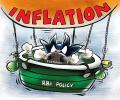
The Reserve Bank of India has increased its retail inflation projection for 2026-27 to 5.1 per cent, up from an earlier estimate of 4.6 per cent. This revision is primarily attributed to mounting input costs, driven by the pass-through of higher global energy prices to domestic petrol and diesel rates, which have seen significant increases since May.

The wholesale price index-based inflation remained negative for the 11th consecutive week since June 6 mainly on high base. It was 12.82 per cent for the corresponding week last year. Prices of inland fish shot up by 25 per cent over the previous week, eggs became dearer by 10 per cent, masur dal was costly by 8 per cent, milk price went up by 5 per cent, and fruits and vegetables became expensive by 3 per cent.

The rail ministry's proposal to reduce transportation tariff for foodgrain by Rs 100 per wagon would not have any cooling effect on food inflation, which was close to 18 per cent for the week ended February 6.

Inflation in food articles during June stood at 2.04 per cent, as against 1.13 per cent in May.

A NielsenIQ report indicates that the FMCG industry's sales growth moderated to 7.8% in the December quarter of 2025, with volume growth also dipping due to GST rationalisation and a high base from the previous year's festival season.

'The real shock is going to be from a deficient monsoon.'
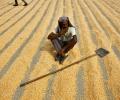
Recommends delisting of chana futures, open to lowering sugar import duty

Deflation masked the rise in food inflation to a 5-month high.

It's only July but the South Korean drama scene is brimming with action and adrenalin.

'I don't see fear becoming a dominant factor for retail investors.'
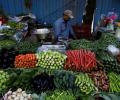
Retail inflation declined to 6.83 per cent in August after touching a 15-month high of 7.44 per cent in July, mainly due to softening prices of vegetables, but still remains above the Reserve Bank's comfort zone. The overall inflation in the food basket stood at 9.94 per cent in August as against 11.51 per cent in July, according to data released by the National Statistical Office (NSO) on Tuesday. Retail inflation based on the Consumer Price Index (CPI) was at 7 per cent in August 2022.
Subdued prices of food items like vegetables pulled down retail inflation for the third month in a row to 5.3 per cent in August, within the RBI's comfort zone. While the Consumer Price Index (CPI)-based retail inflation declined to 5.3 per cent in August from 6.69 per cent in the same month a year ago, food inflation dipped at a much faster pace to 3.11 per cent from 9.05 per cent in August 2020. The food inflation was also lower than 3.96 per cent in preceding month of July.
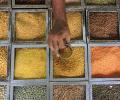
Prices are likely to rise further as demand grows in coming months due to festivals
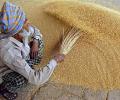
India's wheat and rice reserves in Food Corporation of India (FCI) godowns have surged to 604.02 lakh tonnes as of April 1, nearly three times the mandatory buffer requirement, according to official data.
Following through announcements with enforcement of measures is key, as a run through recent Indian economic history shows, points out A K Bhattacharya.

S&P Global Ratings warns that a sustained rise in crude oil prices to $130 per barrel could significantly slow India's economic growth, weaken fiscal metrics, and strain corporate and banking sector performance, potentially reducing growth by up to 80 basis points.

Agriculture Minister Sharad Pawar on Friday said that the decline in prices of most agricultural commodities in coming weeks will bring down the food inflation, which is 12.63 per cent now.

Amid rising tensions, Iran reportedly launched ballistic missiles toward a US-UK military base, prompting concerns about regional stability and the potential for escalating conflict in the Middle East.

Fitch Ratings on Friday said persistently higher oil prices could cause India's retail inflation to rise faster than the expected gradual pace, and lead to a slowdown in economic growth in the first half of financial year 2026-27 (FY27).

Reliance Industries Ltd (RIL) is preparing for its next phase of growth by establishing advanced manufacturing and export platforms to strengthen its consumer products ecosystem and expand its global footprint, Chairman and MD Mukesh Ambani announced.

The Indian government is accelerating its sale of minority stakes in state-owned companies, including a significant offer for sale (OFS) in Life Insurance Corporation of India (LIC) expected "very soon," to meet its 80,000 crore mobilisation target and reduce its holdings to 75 per cent in most listed PSUs by year-end.

Global investment firm KKR remains optimistic about India's long-term growth, citing rising incomes, premiumisation, financial deepening, and demand for quality services as key drivers for its consumption story, even as higher energy prices and AI disruption pose near-term challenges.

Most members of the Reserve Bank of India's Monetary Policy Committee (MPC) expressed concerns about inflation becoming generalised and highlighted uncertainties surrounding both inflation and growth prospects due to the West Asia conflict, according to the recently released minutes.

A disruption in the supply of LPG cylinders caused by tensions in the Strait of Hormuz is impacting Indian kitchens, leading to restaurant closures, price hikes and a surge in demand for electric cooktops.
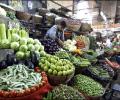
The Consumer Price Index hit the lowest in six months in March at 4.83 per cent.
The United Nations' Food and Agriculture Organisation on Wednesday said global commodity prices were far from easing in the short term owing to tight supply-demand situation and warned of flare ups over food shortage.The UN FAO director general said the world has 4-5 million tonnes (MT) of cereals stocks that can feed the global population for only 8-12 weeks.

Markets will look for clear guidance on how the MPC interprets the uncertainty and what it implies for the future course of monetary policy, points out Rajeswari Sengupta.

India's services sector experienced its strongest growth in six months in May, with the HSBC India Services PMI Business Activity Index rising to 59.8. This expansion was driven by healthy demand, new client acquisitions, and improved new business intakes, alongside a softer rise in cost burdens.

The World Bank has increased India's economic growth projection for FY27 to 6.6 per cent, citing resilient domestic demand, while simultaneously cutting its global economic growth outlook due to the conflict in West Asia.

When her parents insisted Rajini Bhargava pursue an MBA, she presented them the idea of investing in a food truck.

A recently finalised peace deal between the US and Iran, set to be signed on June 19, is expected to significantly benefit India's economy by boosting exports to West Asia, stabilising the rupee, and easing inflationary pressures, according to exporters and experts.

'Our leaders, including Mallikarjun Kharge and Rahul Gandhi, are in touch with all Opposition parties, including the DMK and the AAP.'

'Why not aspire for 8 or 9 or even 10 per cent?'

The central government on Wednesday expressed concern over high food inflation, which is nearing 20 per cent, and asked states to lift more wheat and rice stocks from its pool -- a move that will help increase foodgrain availability and eventually ease prices.

Last year, the country produced about 77.52 million tonnes of fruits, 149.6 million tonnes of vegetables, 104.32 million tonnes of rice and 93.90 million tonnes of wheat.

The closure of the Strait of Hormuz has disrupted some 20 per cent of the global flows but even if it opens, damages to production facilities in the region will take time to repair, points out Sunita Narain.

Non-banking financial companies (NBFCs) reported encouraging results for Q4FY26 with improved asset quality and earnings, but analysts maintain a cautious near-term outlook due to geopolitical tensions, monsoon risks, and specific portfolio concerns.
